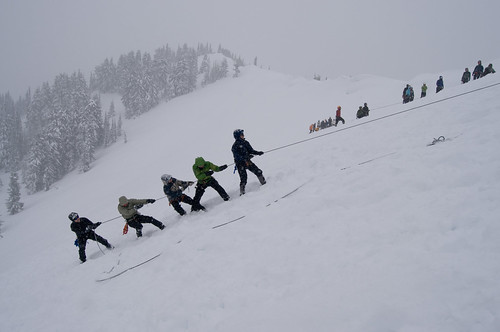
Crevasse rescue! It's for safety!
There was a lot of fun to be had and a lot of learning to do this weekend. The Castner Glacier was the location. Here is a description of the activities.
Before running into the Alaska Range to test out new ski bindings and skins, Greg, who is quite a curler, invited me on Thursday night to run to a ski area that is only open on weekends, skin up, ski down, and run back to Fairbanks before dark (7:00 PM!). We headed out and it was very enjoyable.
On the way up.
Ready for the descent. Goldstream Creek in the background. It was spectacular. Greg is very good at getting up and getting out and fitting in fun things even though there doesn't seem to be enough time. The whole trip lasted about an hour and forty minutes. This was a weeknight! I like his style. He is also a far better skier than me (read: grab skis in the air rather than attempt to stay upright on a jump or, in my case, slowly snowplow past the jump).
On Saturday, I headed out with 15 classmates and three instructors to the Castner Glacier, where Julia and I had visited previously. We were going to attempt to practice crevasse extraction, belaying, repelling, and winter camping.
Food for the trip. Only one Snickers bar of six is left. Homemade oatmeal butter bars (they are what they sound like; 3000 Calories per cubic inch!) were also brought along.
We parked near Castner Creek on the Richardson Highway in the middle of the Delta Mountains in the eastern part of the Alaska Range. The pointy peak to the right is where Julia and I were attempting to get when she slipped, cut her leg, smacked her shin, and asked if I wanted to keep going up.
My wife is incredible. I very much enjoy spending time with her.
Incidentally, on the trip down I hopped in the truck of a guy who has reached the summit of Mount Everest and worked on a crab boat in the Bering Sea, both of which are activities documented by the Discovery Channel on TV shows. He is actually featured on season three of "Everest: Beyond the Limit." "The Deadliest Catch" started long after he quit fishing for crab. Apparently the crab fishing business has toned down quite a bit since he left. He had several interesting stories to tell. Fun guy to listen to.
Skiing in was spectacular. We had blue skies and very little wind. We skied along Castner Creek with a bit of kick wax on alpine skis. It worked pretty well.
We were led by Stan Justice, the facilitator of the class. A little bit about him; he is known as "Mr. Safety" in mountaineering circles in Alaska, he has made much of his own mountaineering clothing (as evidenced by his shirts with velcro-topped-see-through pockets and a rising sun design on the back of his windproof coat), he holds the record for the
Equinox Marathon by a lot, and he knows a lot about ski mountaineering. Lesson learned in this picture: While working on skis, if post-holing six or seven times in thigh deep snow is an unpleasant idea, take off skis, post-hole once, then stomp a small area in the snow. Work on the skis from the area and step back onto the skis to begin moving again. This worked very well when taking skins on and off. The big rock in the background is known as a
glacial erratic.
Moving off Castner Creek and onto Castner Glacier. We wandered around looking for an appropriate spot to camp and practice glacier safety skills.
We camped in this divot in the glacier, likely caused by a
moulin and/or a collapsed
glacier cave.
Another angle of the campsite.
Stan putting in ropes and anchors to practice self-rescue from a crevasse using the Texas prusik system.
An ice axe was used in the self belay position to create the steps above Stan in the picture above. The purpose of climbing was to make sure that the slope did not have a large cornice ready to cause a small avalanche and to cause the slope just above the ropes not to slide if the small avalanche occurred due to the exposure of the underlying snow to sunlight, causing the snow to form a stronger bond with the surface of the glacier. At least that is what Stan said.
Ascending the rope out of the "crevasse." My tentmate Evan was kind enough to snap a few pictures.

Getting to the lip of the crevasse. This is the difficult part if there is no one to help out from the top. It requires tying another prusik knot above the lip of the crevasse one-handed while using the foot prusiks and the other hand as support to stay high enough to reach over the lip of the crevasse to tie the knot. Then another carabiner and sling must be clipped to the newly tied and dressed prusik knot, connecting the prusik above the lip to the harness, allowing the prusiks below the lip of the crevasse to be moved above the lip of the crevasse. This is possible because the fallen climber's weight has been transferred to the prusik above the lip of the crevasse, removing the pressure from between the climbing rope and the lip of the crevasse. It's best to practice with a mitten on to simulate real conditions and avoid frostbite. Prusik knots tied and dressed with one mittened hand while perched on the lip of a crevasse are very difficult. Hopefully the rest of the people on the rope team are good at
z-pulley systems. We practiced pulling someone out of a crevasse using z-pulley systems. Pulleys are useful.

Success! Triumphantly pulling myself out of the crevasse. Notice the helmet worn for safety (no helmet worn by the young lady on the right!). I then rappelled down the rope using a belay device. I learned that it is wise to wrap the rope around the lower back and hold the rope with both hands in order to create more friction for the rappel. This is especially useful after completely tiring out both arms and hands attempting to tie a dang prusik knot above a crevasse lip.
Another view of the glacier walls surrounding the camp.
Good news! The floorless shelter is wind worthy. The weather produced light wind and snow all night long. The shelter allowed for very comfortable sleeping.
The glacier goes several miles further up the valley. Hopefully another trip to the top of the glacier and to a peak or two in the distance will require none of the skills learned on this trip except winter camping. Nonetheless, learning on a glacier is a lot of fun. The Castner Glacier makes for a spectacular classroom.
A song kept running through my head during class this weekend:
"Oh Lord my God, when I in awesome wonder
Consider all the worlds thy hands have made...
When through the wood and forest glades I wander,
I hear the birds sing sweetly in the trees.
When I look down from lofty mountain grandeur
I hear the brook and feel the gentle breeze.
Then sings my soul, my savior God, to thee!
'How great thou art! How great thou art!'"
Yup. It's good to be in an outside classroom.


 Posts
Posts